
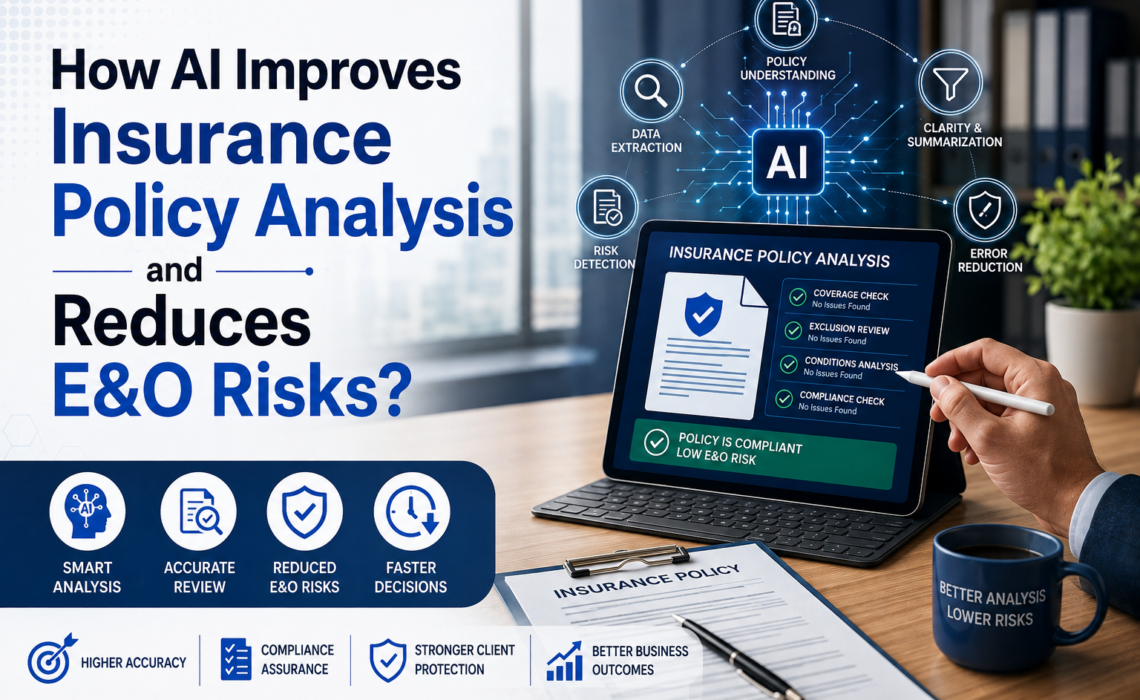
Insurance policies are becoming increasingly complex. From endorsements and exclusions to coverage limits and regulatory requirements, every detail matters. A single oversight during insurance policy analysis can result in Errors & Omissions (E&O) claims, compliance issues, financial losses, or dissatisfied customers.
Traditionally, insurance professionals have relied on manual document reviews to analyze policies. While this approach has served the industry for years, it is often time-consuming, inconsistent, and vulnerable to human error. As policy volumes continue to grow, agencies, brokers, carriers, and MGAs need smarter ways to manage policy reviews without compromising accuracy.
Artificial Intelligence (AI) is changing this landscape. By automating document processing and enhancing decision-making, AI enables faster, more accurate insurance policy analysis while significantly reducing E&O risks.
At Exdion, we help insurance organizations leverage AI-driven solutions to simplify policy analysis, improve operational efficiency, and reduce manual effort across the policy lifecycle.
What Is Insurance Policy Analysis?
Insurance policy analysis is the process of reviewing policy documents to verify coverage details, endorsements, exclusions, deductibles, limits, and policy conditions. It ensures that policies accurately reflect underwriting decisions, comply with regulatory requirements, and meet customer expectations.
Insurance professionals perform policy analysis for several reasons, including:
- Validating policy accuracy
- Comparing renewals and new policies
- Identifying changes in coverage
- Ensuring regulatory compliance
- Supporting underwriting decisions
- Reducing operational risks
Given the complexity of modern insurance policies, manual reviews can be challenging, especially when processing hundreds or thousands of documents.
Why Manual Policy Reviews Increase E&O Risks?
Errors & Omissions (E&O) claims often stem from mistakes made during policy review or administration. Common issues include:
- Missing endorsements
- Incorrect policy interpretation
- Data entry errors
- Overlooked policy changes
- Inconsistent document comparisons
- Failure to identify compliance gaps
Even experienced professionals can unintentionally miss critical details when reviewing lengthy policy documents. These mistakes can lead to claim disputes, financial liability, and reputational damage.
This is why many insurance organizations are turning to AI-powered insurance policy analysis to improve consistency and reduce risk.
How AI Improves Insurance Policy Analysis?
Artificial Intelligence combines technologies such as Natural Language Processing (NLP), Machine Learning (ML), and Intelligent Document Processing (IDP) to analyze insurance documents with speed and precision.
- Automated Data Extraction
One of AI’s biggest advantages is its ability to automatically extract key information from policy documents.
This includes:
- Policy numbers
- Named insured
- Coverage limits
- Deductibles
- Premium amounts
- Effective and expiration dates
- Endorsements
- Exclusions
Instead of manually searching through multiple pages, insurance professionals receive structured information in seconds, reducing processing time and improving accuracy.
- Faster Policy Comparison
Insurance agencies frequently compare:
- Renewal policies
- Quotes versus issued policies
- Policy revisions
- Carrier forms
AI automatically identifies differences between documents, highlighting changes in coverage, endorsements, or exclusions. This allows reviewers to focus on important updates rather than manually comparing lengthy documents line by line.
- Identifying Missing or Inconsistent Information
AI can detect inconsistencies that are easy to overlook during manual reviews.
Examples include:
- Missing endorsements
- Incomplete policy information
- Conflicting coverage details
- Duplicate entries
- Incorrect limits
These automated quality checks help insurance professionals resolve issues before policies are finalized or delivered to clients.
- Supporting Better Underwriting Decisions
Underwriters spend considerable time reviewing policy documents and verifying information. AI streamlines this process by organizing and presenting relevant data in a structured format.
This enables underwriters to focus on evaluating risk rather than spending valuable time searching for information across multiple documents.
- Improving Regulatory Compliance
Insurance regulations continue to evolve, making compliance increasingly complex.
AI helps organizations strengthen compliance by:
- Validating required policy information
- Detecting missing disclosures
- Maintaining audit trails
- Standardizing document reviews
Automated compliance checks reduce the likelihood of regulatory issues while improving governance across insurance operations.
How AI Reduces Errors & Omissions (E&O) Risks?
One of the greatest benefits of AI-powered insurance policy analysis is its ability to reduce Errors & Omissions risks.
AI supports risk reduction by:
- Standardizing policy review processes
- Detecting inconsistencies automatically
- Reducing manual data entry
- Improving document accuracy
- Providing automated validation checks
- Creating transparent audit records
Rather than replacing insurance professionals, AI acts as an intelligent assistant that enhances review quality and minimizes the possibility of costly mistakes.
Business Benefits of AI-Powered Insurance Policy Analysis
Organizations adopting AI-driven insurance policy analysis experience measurable improvements across their operations.
Key benefits include:
- Faster policy review cycles
- Improved document accuracy
- Reduced manual workload
- Lower operational costs
- Greater consistency across reviews
- Enhanced regulatory compliance
- Better customer service
- Reduced Errors & Omissions exposure
These improvements allow insurance teams to focus on strategic activities such as customer engagement, underwriting, and business growth instead of repetitive administrative tasks.
Why Insurance Organizations Choose Exdion?
Technology alone is not enough—successful transformation requires insurance expertise.
At Exdion, we combine deep industry knowledge with AI-powered automation to help insurers, brokers modernize their policy operations.
Our solutions help organizations:
- Automate insurance policy analysis
- Extract and validate policy information
- Compare policy versions more efficiently
- Improve operational accuracy
- Reduce manual processing time
- Strengthen compliance
- Minimize Errors & Omissions risks
We believe AI should empower insurance professionals—not replace them. By automating repetitive tasks, our solutions enable teams to make faster, more informed decisions while delivering better service to their customers.
The Future of Insurance Policy Analysis
As insurance products become more complex and customer expectations continue to evolve, AI will play an increasingly important role in policy operations.
Organizations that embrace AI-powered insurance policy analysis today will be better positioned to improve efficiency, enhance compliance, reduce operational risk, and scale their businesses with confidence.
Conclusion
Accurate insurance policy analysis is essential for reducing operational risk, ensuring compliance, and delivering exceptional customer service. While manual reviews remain important, they are no longer sufficient to meet the demands of today’s insurance industry.
AI provides a smarter approach by automating document analysis, identifying inconsistencies, improving policy accuracy, and significantly reducing Errors & Omissions risks.
At Exdion, we are committed to helping insurance organizations modernize policy analysis through intelligent automation and AI-powered solutions. By combining technology with deep insurance expertise, we enable our clients to streamline operations, improve decision-making, and confidently prepare for the future.